
How to Use Oestrogen Patches, Gel, Spray and Tablets for Menopause
Article written by Dr Mari Walling, British Menopause Society Registered Specialist, GP, Co-Founder of Lemala Health, November 2025. This information is not a substitute for professional medical advice, diagnosis, or treatment. Always consult your healthcare provider for personal guidance.
Oestrogen can be taken in several different forms during perimenopause and menopause, including patches, gel, spray and tablets. Many women ask which type of oestrogen HRT is best, and how to use each option correctly.
In this guide, we explain how each type works, how to use them correctly, and how to choose the most suitable option for you.
What is systemic oestrogen?
Systemic oestrogen forms part of Hormone Replacement Therapy (HRT), also known as Menopause Hormone Therapy (MHT).
There are several ways to take oestrogen: patches, gels, sprays and oral tablets are the most commonly used methods in the UK.
At Lemala Health, we generally prefer to prescribe what we call ‘transdermal’ oestrogen, which is oestrogen that is delivered via the skin into the bloodstream. These are the safest and most effective ways to replace oestrogen during perimenopause and menopause.
Transdermal oestrogen does not need to pass through your stomach or liver so you can take a much lower dose. Transdermal oestrogen appears to have little or no impact on clotting factors and so can be used safely in women with a history of blood clotting or migraines.
It can be used as a patch, gel or spray, and all three options contain body-identical 17β-oestradiol, the same type of oestrogen your ovaries naturally produce.

Oestrogen patches
Oestrogen patches are applied as a translucent plaster.
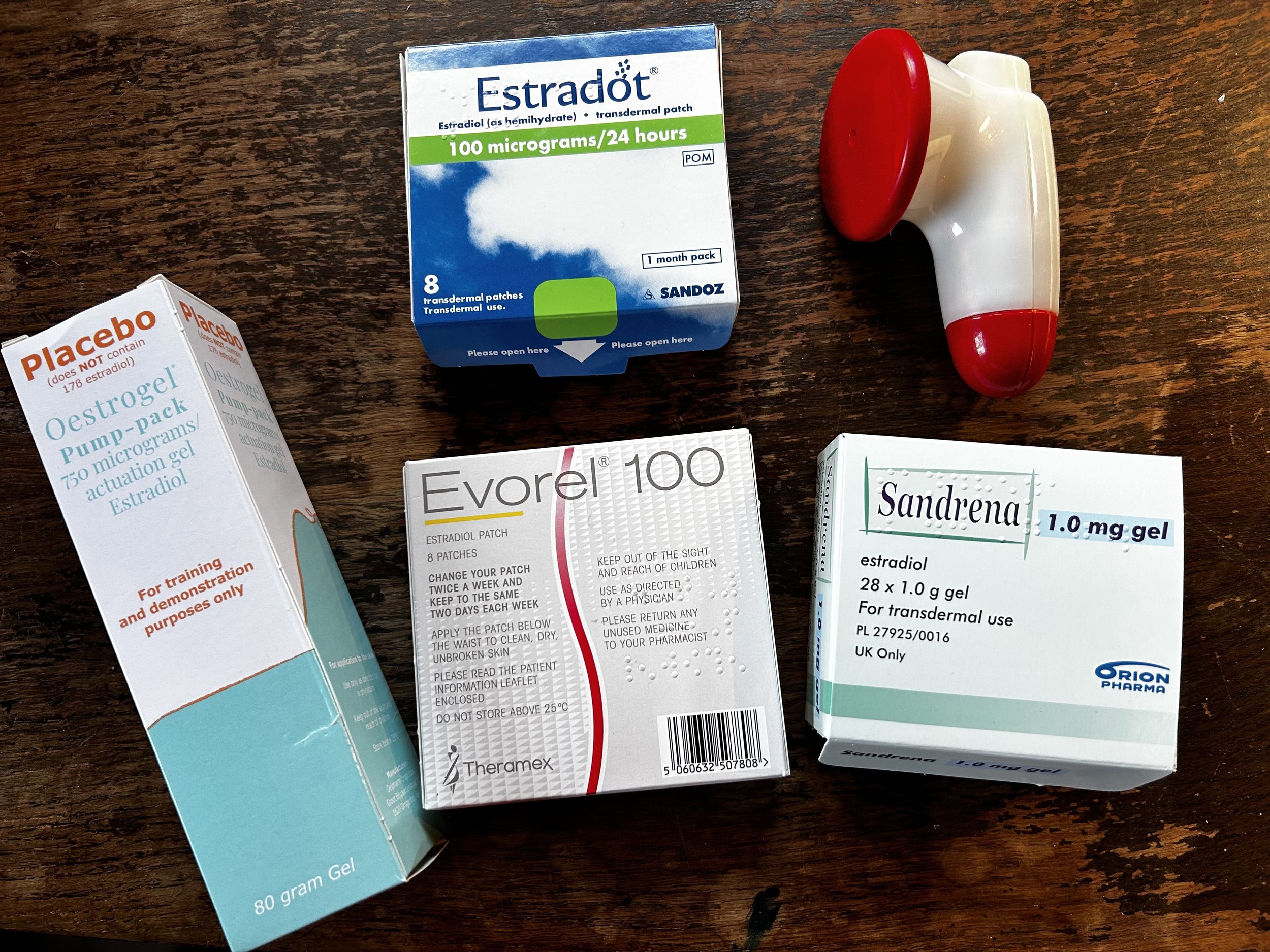
Patches deliver a continuous dose of oestrogen and are changed once or twice weekly depending on the brand.
Patches can be particularly effective for migraine sufferers, who benefit from the steady dose. They can also be helpful for women who prefer something low-maintenance or who want to avoid daily applications.
How to apply patches:
Apply to clean, dry skin below the waist - the hip, outer thigh, lower abdomen or buttock
Do not apply moisturiser or oils underneath.
Smooth the patch on firmly for 10–20 seconds.
Rotate application sites to reduce skin irritation.
They stay on through bathing, swimming and exercise.
If the patch falls off, put on a new one and continue your usual schedule.
A plaster mark will occur when they are taken off the skin, which can be removed using baby oil or eye make-up remover and a dry flannel.
Oestrogen gel
Oestrogen gel is applied daily and absorbed quickly through the skin.
There are two gel preparations available, Oestrogel and Sandrena.
Oestrogel (pump): each pump contains 64 doses. Sandrena gel (sachets), come as sachets in two different strengths. There is less quantity of gel for the same dose compared to Oestrogel so it can be more practical in higher doses, or useful for travelling.
How to apply:
Apply daily and to clean dry skin. Usually in the morning, although you can be split it into morning and evening applications if preferred.
Apply to outer arms, or inner thighs. Spread the gel over a large area of skin.
Avoid applying to your breast and genital areas.
Try not to apply multiple pumps to the same area. Spread each pump or sachet across different areas of skin, as advised by your clinician.
Allow 2–5 minutes to dry before dressing.
Wait at least an hour after application before bathing or swimming.
Wash your hands afterwards.
Be careful not to transfer gel to partners, children or pets before it’s dry.
Oestrogen spray (Lenzetto)
Lenzetto is a fine spray. It forms a “reservoir” under the skin, releasing oestrogen steadily over 24 hours.
Each bottle contains 56 sprays.
How to apply the spray:
Before first use, prime the bottle by spraying three times with the cap on.
Apply daily to clean, dry skin on the inner forearm or inner thigh.
Spray onto a small circular area and avoid overlapping yesterday’s spot.
Allow to dry (~1 minute).
Avoid washing the area for at least 30 minutes.
Oestrogen tablets
Tablets can be convenient and are still widely prescribed in the UK – especially when other risk factors are low, if you have skin problems such as widespread eczema, or if you struggle to absorb transdermal products.
You usually take them once a day. Some risks associated with HRT, such as blood clots, are slightly higher with tablets compared to transdermal forms, although the overall risk remains low.
There’s also a new body identical tablet called Bijuve which is suitable for postmenopausal women and contains body identical oestrogen and progesterone.
Important considerations
If you still have a womb, you will also need progesterone for endometrial protection. This can be taken as micronised progesterone capsules, a Mirena IUS, or within a combined patch.
There is no single “best” method. The right option is whichever you find comfortable, easy to use and effective.
It is important to take the medication as prescribed. Try and be consistent with whatever option you chose. Stopping and starting, or missing doses, can cause hormone levels to fluctuate and may affect how well your treatment works.
We would always advise women to try one and if you don’t get on well with it, you can try a different one, ideally after a few months of settling in.
Choosing the right type of oestrogen
There is no single “best” form of oestrogen. The right option depends on your symptoms, medical history, lifestyle and personal preference.
Transdermal oestrogen (patch, gel or spray) is often preferred because it provides steady hormone levels and carries a lower risk of blood clots. However, tablets may be suitable for some women depending on individual circumstances.
If you are unsure which type of oestrogen is right for you, or if your current HRT isn’t working as expected, a personalised review can help. You can explore appointments with our menopause specialists at Lemala Health.